James Gandolfini, the larger-than-life Emmy award-winning actor who played mob boss Tony Soprano, has met his end in Rome, due to an apparent heart attack. At age 51, his passing was entirely premature.
As Tony Soprano, Gandolfini insinuated himself into popular culture as the big, menacing, complex and implacable mobster who ruled his criminal empire with old-school, strong-arm tactics. But every tough guy knows that there’s someone – or something – tougher out there. For Tony Soprano, the hit man was likely heart disease.
The much-beloved Gandolfini was by all accounts a marvelous friend and deeply respected by his peers. He had a charismatic personality and a great sense of humor. He was also very overweight, a cigar smoker and a man known to remain at the dinner table until the last strands of pasta and crumbs of tiramisu had been taken care of. As Tony Soprano, he could menace just about anybody. But as actor Gandolfini, his lifestyle vulnerabilities made him an easy target for a highly efficient silent killer.
As famous as he was, Gandolfini’s death added only a tiny notch in the belt of the ultimate assassin: heart disease. Gandolfini was just one of the more than 600,000 people to fall victim to fatal heart disease in the U.S. each year. The difference between Gandolfini and all other victims of cardiovascular disease is that he was globally famous.
What we can learn from a meteoric life - lived large and ended too soon - is that no matter who you are, no matter how famous, rich, awarded and popular you become, heart disease can get you.
Obesity is associated with increased rates of heart attack, stroke, high blood pressure and arterial disease. Tobacco smoking is also a major cardiovascular risk factor. Consistently large eating habits can lead to a large coronary event. Gandolfini did it all: lived too heavy, enjoyed his fine cigars and packed in the food. Like a recipe for a perfect marinara, Gandolfini’s life was a perfect formula for a heart attack.
At this point in time, the rules of cardiovascular health are fairly well understood. Eating foods low in fat, exercising daily, eradicating any and all smoking from your life and reducing stress are all factors in maintaining a healthy heart and living longer.
Omega-3 fatty acids from fish appear to be significantly protective to the heart and eating lots of soluble and insoluble fiber helps to regulate metabolism, eliminate waste, control blood sugar and reduce cardiovascular disease risk. Herbs like hawthorn and green tea and supplements like OPC’s and Coenzyme Q 10 can help you to keep your heart healthier, longer. But lifestyle still matters most.
We become attached to celebrities in our imagination. We watch them perform, relate in various ways to the characters they portray, celebrate their on-stage victories and feel for them in their scripted defeats. According to those who knew him, Gandolfini was nothing like Tony Soprano. He was instead a softer, more thoughtful man and a highly driven actor who put his all into his performances and enjoyed a wide range of friends. And that makes his death even sadder.
Nobody here gets out alive. How long we get to stick around depends to a great extent upon how we live. Violate the fundamental code of healthy living and you’ll be taken out. Don’t let television characters, however tough they are portrayed, mislead you into thinking that anybody can sidestep the basics. We are all responsible to live out our days with care for our bodies. Maintaining a healthy weight, eating clean food and avoiding major health risks like smoking are all smart strategies.
James Gandolfini will be missed. The accolades will pour in. His family and friends will weep. The funeral will get international coverage. Talk shows will discuss him for weeks. Re-runs of “The Sopranos” will get a new life. But for the big mob boss whose giant personality dominated television for years, it’s closing time. Bye, Tony. We’ll miss you.
Showing posts with label heart attack. Show all posts
Showing posts with label heart attack. Show all posts
Monday, June 24, 2013


Monday, February 25, 2013

Thursday, January 3, 2013
Obese people at 29% higher risk of premature death
People who are obese have a 29% increased risk of premature death.
This could come as a wake-up call for 8 million women and 4.4 million men in India who are obese (body mass index of 30 kg/m2).
One of the largest analyses done - 100 studies that included 3 million adults - has found that obesity was associated with a significantly higher all-cause risk of death.
In this meta-analysis that looked at 2.7 lakh deaths that occurred in the US, Europe, Mexico, India, Israel, Brazil, Japan, Taiwan, China and Australia, researchers found a 18% higher risk of death for obesity - BMI equal or higher than 30 and a 29% increased risk of death among those whose BMI was higher than 35.
The study says that the presence of a wasting disease, heart disease, diabetes, renal dialysis or older age are all associated with an inverse relationship between BMI and mortality rate, an observation termed the obesity paradox.
Over one in 10 adults, who 20 years and above, are obese globally.
That's over half a billion people (205 million men and 297 million women were obese in 2008).
Researchers say excess bodyweight is an important risk factor for mortality and morbidity from cardiovascular diseases, diabetes, cancers and musculoskeletal disorders, causing nearly three million deaths every year worldwide.
While the number of obese men in India increased from 2.3 million to 4.4 million between 1980 and 2008, the number increased from 2.1 million to 8 million among women during the same period
According to the study that was published on the January 2nd issue of the Journal of American Medical Association (JAMA), "Estimates of the relative mortality risks associated with normal weight, overweight and obesity may help to inform decision making in the clinical setting."
Katherine Flegal, of the National Center for Health Statistics, Centers for Disease Control and Prevention, conducted the study to compile and summarize published analyses of body mass index (BMI) and all-cause mortality that provide hazard ratios (HRs) for standard BMI categories.
All-cause mortality HRs for overweight (BMI of 25 and 30), obesity (BMI of 30), grade 1 obesity (BMI of 30-35), and grades 2 and 3 obesity (BMI of 35) were calculated relative to normal weight (BMI of 18.5-25).
The researchers found that the summary HRs indicated a 6% lower risk of death for overweight; a 18% higher risk of death for obesity (all grades), a 5% lower risk of death for grade 1 obesity and a 29% increased risk of death for grades 2 and 3 obesity.
Professor Majid Ezzati from the School of Public Health at Imperial College London had said, "Excess bodyweight is a major public health concern."
Now, India is in the grip of an obesity epidemic. Experts say the trend needs to be immediately arrested by taxing junk food, restricting food ads and making food labelling clearer.
A study that looked at the burden of overweight citizens in six countries - Brazil, China, India, Mexico, Russia and South Africa - has found that between 1998 and 2005, India's overweight rates increased by 20%. Currently, almost one in five men and over one in six women are overweight. In some urban areas, the rates are as high as 40%.
Published in the Lancet by the Organization for Economic Co-operation and Development ( OECD), the annual cost of broad-based prevention strategies tackling obesity and other health threats, such as alcohol consumption, smoking, high blood pressure and cholesterol, would be less than $2 per person per year in India.
Obesity is the root for several non-communicable diseases (NCDs). Another study in the Lancet predicted that by 2030, nearly 70% of all global deaths will be from non-communicable diseases like cancer, diabetes, and respiratory and heart disease. Of these 70% of fatalities, 80% will be in less wealthy nations like India.
According to WHO, NCDs - principally cardiovascular diseases, diabetes, cancers and chronic respiratory diseases - caused an estimated 35 million deaths in 2005. This figure represents 60% of all deaths globally, with 80% of deaths due to noncommunicable diseases occurring in low- and middle-income countries, and approximately 16 million deaths involving people below 70 years.
The total deaths from NCDs are projected to increase by a further 17% over the next 10 years.
Up to 80% of heart disease, stroke and type-2 diabetes and over a third of cancers can be prevented by eliminating shared risk factors, mainly tobacco use, unhealthy diet, physical inactivity and the harmful use of alcohol.
This could come as a wake-up call for 8 million women and 4.4 million men in India who are obese (body mass index of 30 kg/m2).
One of the largest analyses done - 100 studies that included 3 million adults - has found that obesity was associated with a significantly higher all-cause risk of death.
In this meta-analysis that looked at 2.7 lakh deaths that occurred in the US, Europe, Mexico, India, Israel, Brazil, Japan, Taiwan, China and Australia, researchers found a 18% higher risk of death for obesity - BMI equal or higher than 30 and a 29% increased risk of death among those whose BMI was higher than 35.
The study says that the presence of a wasting disease, heart disease, diabetes, renal dialysis or older age are all associated with an inverse relationship between BMI and mortality rate, an observation termed the obesity paradox.
Over one in 10 adults, who 20 years and above, are obese globally.
That's over half a billion people (205 million men and 297 million women were obese in 2008).
Researchers say excess bodyweight is an important risk factor for mortality and morbidity from cardiovascular diseases, diabetes, cancers and musculoskeletal disorders, causing nearly three million deaths every year worldwide.
While the number of obese men in India increased from 2.3 million to 4.4 million between 1980 and 2008, the number increased from 2.1 million to 8 million among women during the same period
According to the study that was published on the January 2nd issue of the Journal of American Medical Association (JAMA), "Estimates of the relative mortality risks associated with normal weight, overweight and obesity may help to inform decision making in the clinical setting."
Katherine Flegal, of the National Center for Health Statistics, Centers for Disease Control and Prevention, conducted the study to compile and summarize published analyses of body mass index (BMI) and all-cause mortality that provide hazard ratios (HRs) for standard BMI categories.
All-cause mortality HRs for overweight (BMI of 25 and 30), obesity (BMI of 30), grade 1 obesity (BMI of 30-35), and grades 2 and 3 obesity (BMI of 35) were calculated relative to normal weight (BMI of 18.5-25).
The researchers found that the summary HRs indicated a 6% lower risk of death for overweight; a 18% higher risk of death for obesity (all grades), a 5% lower risk of death for grade 1 obesity and a 29% increased risk of death for grades 2 and 3 obesity.
Professor Majid Ezzati from the School of Public Health at Imperial College London had said, "Excess bodyweight is a major public health concern."
Now, India is in the grip of an obesity epidemic. Experts say the trend needs to be immediately arrested by taxing junk food, restricting food ads and making food labelling clearer.
A study that looked at the burden of overweight citizens in six countries - Brazil, China, India, Mexico, Russia and South Africa - has found that between 1998 and 2005, India's overweight rates increased by 20%. Currently, almost one in five men and over one in six women are overweight. In some urban areas, the rates are as high as 40%.
Published in the Lancet by the Organization for Economic Co-operation and Development ( OECD), the annual cost of broad-based prevention strategies tackling obesity and other health threats, such as alcohol consumption, smoking, high blood pressure and cholesterol, would be less than $2 per person per year in India.
Obesity is the root for several non-communicable diseases (NCDs). Another study in the Lancet predicted that by 2030, nearly 70% of all global deaths will be from non-communicable diseases like cancer, diabetes, and respiratory and heart disease. Of these 70% of fatalities, 80% will be in less wealthy nations like India.
According to WHO, NCDs - principally cardiovascular diseases, diabetes, cancers and chronic respiratory diseases - caused an estimated 35 million deaths in 2005. This figure represents 60% of all deaths globally, with 80% of deaths due to noncommunicable diseases occurring in low- and middle-income countries, and approximately 16 million deaths involving people below 70 years.
The total deaths from NCDs are projected to increase by a further 17% over the next 10 years.
Up to 80% of heart disease, stroke and type-2 diabetes and over a third of cancers can be prevented by eliminating shared risk factors, mainly tobacco use, unhealthy diet, physical inactivity and the harmful use of alcohol.
Sunday, December 23, 2012
9 Foods You Should Be Eating for Type 2 Diabetes
Healthy eating for type 2 diabetes is about losing weight and preventing dangerous spikes in blood sugar. Nutrition and health expert Joy Bauer explains how these nine foods can help.
Foods for Diabetes
Sunday, November 11, 2012
THE FATTIEST FOODS IN AMERICA

THE FATTIEST FOODS IN AMERICA

6. FAT OFFENDER #6: A BURGER : Ruby Tuesday Triple Prime Bacon Cheddar Burger
New rule: The more syllables in a menu item's name, the more fat there's likely to be in the dish. Less than 3 percent of the beef produced in this country earns the USDA's "prime" rating, and that's not a bad thing. Prime beef, as it turns out, is the fattiest beef you can sink your teeth into. If you really want a burger, you're better off heading elsewhere. Not one of Ruby's has fewer than 700 calories. Go with the Plain Grilled Top Sirloin and earn all the beefy protein without the superfluous calories.
EAT THIS INSTEAD!
Plain Grilled Top Sirloin

5. FAT OFFENDER #5: A STEAK: Chili’s Flame-Grilled Ribeye with broccoli and mashed potatoes
For a healthy diet, the USDA recommends you cap your daily saturated fat intake at 20 grams. This meal more than doubles that, and it's only 12 ounces of meat. Sure, ribeye is a notoriously fatty cut, but it's primarily the bath of butter that pushes this steak's fat count to such unhealthy heights. Switch to the Guiltless Grill Classic Sirloin and save an astounding 1,090 calories.
EAT THIS INSTEAD!
Guiltless Grill Classic Sirloin with steamed veggies

4. FAT OFFENDER #4: MEXICAN FOOD: Chili’s Bacon Ranch Chicken Quesadilla
Traditional Mexican food is big on seasoning and light on cheese, but with this quesadilla, Chili's takes a different approach. Trying to appease palates primed for indulgence, the restaurant layers on the fat in four ways: cheese, ranch, bacon, and sour cream. Go with the Margarita Grilled Chicken and you'll cut the overall fat content by more than 80 percent.
EAT THIS INSTEAD!
Margarita Grilled Chicken

3. FAT OFFENDER #3: A 'HEALTHY' SALAD: IHOP Chicken and Spinach Salad
Chicken? Good. Spinach? Good. IHOP’s Chicken and Spinach Salad—downright deplorable. You'll need to i-hop for four hours to burn it off. This salad is exactly what makes restaurant food so questionable and potentially unhealthy. The name makes it sound like a paragon of nutritious eating, yet the numbers reveal it to be just the opposite. The chicken here is actually fried chicken, and the spinach is little more than a small bed for bacon and cheddar cheese. You could snarf down six pancake short stacks and still take in less fat. Save yourself the waistline damage and opt for the Simple & Fit Simply Chicken Sandwich instead.
Click here for all of today's nutrition, health, and fitness news!
EAT THIS INSTEAD!
Simply Chicken Sandwich with fresh fruit, side salad, and reduced-fat Italian dressing

2. FAT OFFENDER #2: 'HEALTHY' FISH: Applebee’s New England Fish & Chips
The American Heart Association recommends eating fish rich in omega-3 fatty acids at least twice a week. By doing so, you lower your risk of such chronic diseases as heart disease and cancer. But if you prepare fish by deep frying it in a tub of bubbling fat—like Applebee's does with this artery-clogging monstrosity—you reverse all those benefits. Opt for Applebee's Garlic Herb Salmon instead. It offers 109 fewer grams of fat, nearly two-thirds fewer calories, and a heap of flavor that will still leave you satiated.
EAT THIS INSTEAD!
Applebee’s Garlic Herb Salmon

1. FAT OFFENDER #1: PASTA: Cheesecake Factory Fettuccini Alfredo with Chicken
Cheesecake Factory prefers to keep its nutritional stats hidden, but a law in California forced it to reveal saturated fat. Total fat is still a mystery, but this meal breaks through the 100-gram ceiling on saturated fat alone! The culprits here are the oversized portion and the thick, fat-riddled alfredo sauce. The typical restaurant recipe for this sauce relies on some combination of cream, butter, oil, and cheese, and there's no reason to believe that Cheesecake's version strays from the norm. Unfortunately, the chain offers no single pasta dish with fewer than 1,100 calories, so keep yourself safe by sticking to the new Skinnylicious menu.
Tuesday, October 9, 2012
Would you eat a stack of 16 sugar cubes?
This website breaks down the sugar content in common things you eat and drink.
http://www.sugarstacks.com/
http://www.sugarstacks.com/
Thursday, September 27, 2012
2 year anniversary!
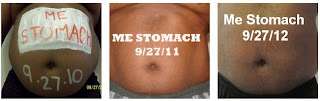
Today makes 2 years since I started this blog. I've had my ups and downs, but I'm still focused. My BMI is now 34.6. Continue to follow my progress.

Monday, September 17, 2012
Thursday, July 5, 2012
Sunday, July 1, 2012

Thursday, June 28, 2012
Monday, June 4, 2012

Sunday, June 3, 2012
Life is about to change.
Full time at Train Studios today and new eating habits to go along with it. Most dairy, sugar, fruit, butter, salad dressings, potatoes, rice, pasta, most meats and other things are not allowed. They said No Snacks, if you are hungry drink water! I'm ready.
Watch and see my progress.
Watch and see my progress.
Thursday, May 31, 2012


Training harder!
Today turning another new leaf. I've reached a plateau with my weight. So I need to turn up the steam! Friend of mine has been going to a new gym and lost over 40 ibs in about 4 months. I ran into the owner last night and mentioned I had did 36 miles biking the day before. He told me that is not going to help me with weight loss. My body needs constant change. So today I'm going to do a free session at Train Studios. Monday, June 4th I will officially enroll.
Follow me as I continue to reach my goal weight.
Follow me as I continue to reach my goal weight.
Tuesday, May 29, 2012
Friday, May 25, 2012
Thursday, May 10, 2012
Obesity could affect 42% of Americans by 2030
WASHINGTON – A new forecast on America's obesity crisis has health experts fearing a dramatic jump in health care costs if nothing is done to bring the epidemic under control.

Jeff J Mitchell, Getty Images
"The obesity problem is likely to get much worse without a major public health intervention," says health economist Eric Finkelstein.
Sponsored Links
The new projection, released here Monday, warns that 42% of Americans may end up obese by 2030, and 11% could be severely obese, adding billions of dollars to health care costs.
"If nothing is done (about obesity), it's going to hinder efforts for health care cost containment," says Justin Trogdon, a research economist with RTI International, a non-profit research organization in North Carolina's Research Triangle Park.
MORE: BMI calculator
As of 2010, about 36% of adults were obese, which is roughly 30 pounds over a healthy weight, and 6% were severely obese, which is 100 or more pounds over a healthy weight.
The obesity epidemic:

Reporter Nanci Hellmich's latest coverage on the obesity epidemic that is crippling the country.
- More obese people have joint pain, heart conditions
- Obesity rate inches up for males, but levels off overall
- It's an uphill climb for obese kids and their parents
- Family plays key role in monitoring a child's weight
- Study finds gene variants behind childhood obesity risk
"The obesity problem is likely to get much worse without a major public health intervention," says Eric Finkelstein, a health economist with Duke University Global Health Institute and lead researcher on the new study.

The analysis was presented at the Centers for Disease Control and Prevention's "Weight of the Nation" meeting. The study is being published online in the American Journal of Preventive Medicine.
The increase in the obesity rate would mean 32 million more obese people within two decades, Finkelstein says. That's on top of the almost 78 million people who were obese in 2010.
Extra weight takes a huge toll on health, increasing the risk of type 2 diabetes, heart disease, stroke, many types of cancer, sleep apnea and other debilitating and chronic illnesses.
"Obesity is one of the biggest contributors for why healthcare spending has been going up over the past 20 years," says Kenneth Thorpe, a professor of health policy at Emory University in Atlanta.
The obesity rate was relatively stable in the USAbetween 1960 and 1980, when about 15% of people fell into the category. It increased dramatically in the '80s and '90s and was up to 32% in 2000 and 36% in 2010, according to CDC data. Obesity inched up slightly over the past decade, which has caused speculation that the obesity rate might be leveling off.
Finkelstein, Trogdon and colleagues predicted future obesity rates with a statistical analysis using different CDC data, including body mass index, of several hundred thousand people. Body mass is a number that takes into account height and weight. Their estimates suggest obesity is likely to continue to increase, although not as fast as it has in the past.
Finkelstein says the estimates assume that things have gotten about as bad as they can get in the USA, in terms of an environment that promotes obesity. The country "is already saturated" with fast-food restaurants, cheap junk food and electronic technologies that render people sedentary at home and work, he says. "We don't expect the environment to get much worse than it is now, or at least we hope it doesn't."
In an earlier study, Finkelstein and experts from the CDC estimated that medical-related costs of obesity may be as high as $147 billion a year, or roughly 9% of medical expenditures. An obese person costs an average of $1,400 more in medical expenses a year than someone who is at a healthy weight, they found. Other researchers have estimated the costs may be even higher.
If the obesity rate stays at 2010 levels instead of rising to 42% as predicted, then the country could save more than $549.5 billion in weight-related medical expenditures between now and 2030, says study co-author Trogdon.
Patrick O'Neil, president of the Obesity Society, a group of weight-control researchers and professionals, says that these new projections "indicate that even more people will be losing loved ones and others will be suffering sickness and living lives that fall short of their promise because of obesity."
There's no one-size-fits all solution to a complex problem that has been decades in the making, says Sam Kass, assistant chef and senior policy advisor for Healthy Food Initiatives at the White House. "This national conversation — this national movement — must continue. This is literally life and death we are talking about."
How can you lose weight and keep it off for good?
Successful dieters in the National Weight Control Registry, a group of 10,000 people who have lost 30 pounds or more and maintained that loss for a year or more, have developed many weight-control strategies. For instance, they:
•Follow a low-calorie, low-fat diet of about 1,800 calories a day.
•Keep track of food intake.
•Count calories, carbs or fat grams or use a commercial weight-loss program to track food intake.
•Walk about an hour a day or burn the same calories doing other physical activities.
•Eat breakfast regularly, often including whole grains and low-fat dairy products.
•Limit dining out to an average of three times a week, and fast food to less than once a week.
•Eat similar foods often and don't splurge much.
•Watch fewer than 10 hours of TV a week.
•Weigh themselves at least once a week.
Thursday, March 1, 2012
Thursday, February 16, 2012
Subscribe to:
Posts (Atom)